

Your new director starts Monday. The laptop is ready and the welcome email is drafted. You have a clear picture of what the first ninety days should look like, yet none of it is written down.
By the end of the first month, you and your new hire are working from different pictures. You wanted them to learn the clients first. They started rewriting the review process. Neither of you did anything wrong, you just aren't on the same page.
In a recent post, I covered why senior hires stall without a success profile, which defines what winning looks like in the role. This post covers what you hand over before day one, so you both start with the same expectations.
What to include
Keep it to one page. A longer plan won't get used. It needs five parts:
What they own. The functions that are theirs from day one.
What they decide without you. The decisions that don't need to come back to you, with a limit where one matters, such as a dollar amount.
One result at 30, 60, and 90 days. Make each one measurable. If someone outside the room can't tell whether it happened, rewrite it.
The check-in cadence. Who meets with whom, how often, and what gets reviewed. Silence in a check-in tells you something too, and the signs founders miss are worth knowing.
What you stop doing. The tasks that move off your plate, and the date they move. Skip this part and you keep doing the work you hired them to take over. Every question that still routes through you adds to your founder tax.
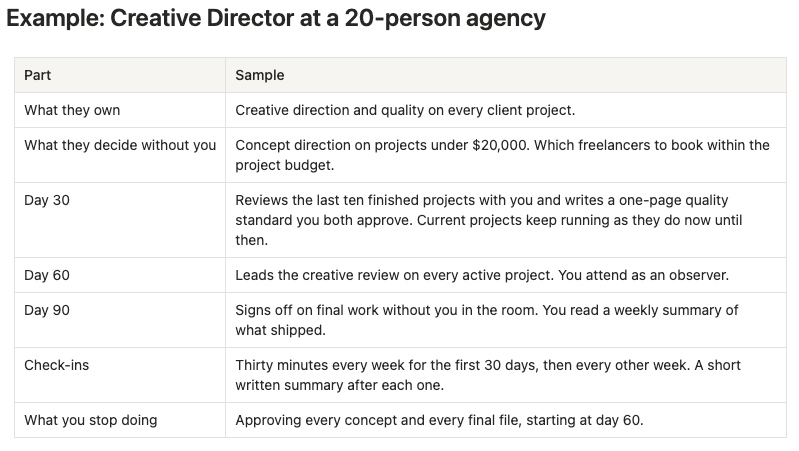
Look at the day 30 row. It asks the new hire to write down what good work means at your agency before changing anything. Senior people want to fix things fast, which is part of why you hired them. Point that energy at a specific target and date.
Walk through it together on day one
Go through the plan together on the first day. Ask what is unclear and what they would change. Adjust it that day, in writing.
Keep that habit. If a target changes at day 45, the plan changes too, with both of you aware of it.
If you're in California, call the first 90 days an introductory period in your offer letter and state that employment is at-will throughout. CalChamber's HR California says that wording does not conflict with at-will employment, and that ending the job early still gives you no protection from wrongful termination claims. Have your employment attorney review your wording.
If the 30-day result is missed
Before you decide the person is wrong, ask two questions. Was the result clear to both of you? Did they have the access and information to reach it?
If either answer is no, fix the plan. If both answers are yes, you have a performance conversation to hold, and the plan gives you something specific to discuss.
Write it before the start date
Put one result at each stage and one task you hand over. Your new hire gets a target from the first morning, and you get something to review at day 90.
If you want a second set of eyes on it before day one, contact us.
